| Bitcoin |
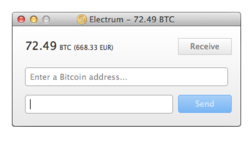
A digital Bitcoin wallet
|
| Ledger |
The majority of the Bitcoin peer-to-peer network regulates transactions and balances.[1][2] |
| Date of introduction |
3 January 2009 |
| Source |
Bitcoin Genesis Block |
| User(s) |
International |
| Issuance |
Limited release |
| Source |
Total BTC in Circulation |
| Method |
The rate of new bitcoin creation will be halved every four years until there are 21 million BTC[3] |
| Subunit |
|
| .001 |
mBTC (millicoin) |
| .000001 |
μBTC (microcoin) |
| .00000001 |
satoshi[4] |
| Symbol |
BTC, XBT,[5]  , ฿ (note: this also is the baht symbol),[6] Ƀ[7] , ฿ (note: this also is the baht symbol),[6] Ƀ[7] |

A common Bitcoin logo.
Bitcoin (
sign:
; code:
BTC or
XBT[8]) is a
distributed peer-to-peer digital currency that functions
without the intermediation of any central authority.
[9] The concept was introduced in a 2008 paper by a
pseudonymous developer known only as "Satoshi Nakamoto".
[1]
Bitcoin is called a
cryptocurrency since it is decentralized and uses cryptography to prevent
double-spending, a significant challenge inherent to digital currencies.
[9] Once validated, every individual transaction is permanently recorded in a public ledger known as the blockchain.
[9]
The calculations required to authenticate Bitcoin transactions are
completed using a network of private computers often specially tailored
to this task.
[10]
As of May 2013,
the Bitcoin network processing power "exceeds the
combined processing strength of the top 500 most powerful
supercomputers".
[11]
The operators of these computers, known as "miners", are rewarded with
transaction fees and newly minted bitcoins. However, new bitcoins are
created at an ever-decreasing rate.
[9] Once 21 million bitcoins are distributed, issuance will cease.
[9] As of August 2013, approximately 11.5 million bitcoins were in circulation.
[12]
In 2012,
The Economist reasoned that Bitcoin has been popular due to "its role in dodgy online markets,"
[13] and in 2013 the FBI shut down one such service,
Silk Road,
which allowed the sale of illegal drugs for bitcoins. However, bitcoins
are increasingly used as payment for legitimate products and services.
[14] Notable vendors include
Wordpress,
OkCupid,
Reddit, and Chinese Internet giant
Baidu.
[15]
Speculators have been attracted to Bitcoin, fueling volatility and
price swings. In July 2013, Cameron and Tyler Winklevoss asserted that
"there is relatively small use of bitcoins in the retail and commercial
marketplace in comparison to relatively large use by speculators."
[16]
1.2 Payment network and mining

A diagram of a bitcoin transfer.
The Bitcoin network protocol operates to provide solutions to the
problems associated with creating a decentralized currency and a
peer-to-peer payment network. Key among them is the use of a blockchain
to achieve consensus and to solve the
double-spending problem.
A bitcoin is defined by a chain of digitally-signed transactions that began with its creation as a block reward through
bitcoin mining.
Each owner transfers bitcoins to the next by digitally signing them
over to the next owner in a Bitcoin transaction. A payee can then verify
each previous transaction to verify the chain of ownership.
3 Economics
Large fluctuations in the value of Bitcoin have led to criticism of its usefulness as a currency.
[93] In addition, its deflationary bias encourages
hoarding.
[94] This reduces the the use value of a currency and has been the downfall of other private currencies.
[95] However, currently Bitcoin does see some use as a currency
[96] as well as being saved by individuals.
[97]
3.1 Exchanges
Through various
exchanges,
bitcoins are bought and sold at a variable price against the value of
other currency. Bitcoin has appreciated rapidly in relation to other
currencies including the
US dollar,
euro and
British pound.
[84][98][99]
Bitcoin exchanges regularly fail, and the vast majority of
transactions are completed on a single exchange that was originally a
site for trading Magic: The Gathering cards online, Mt. Gox.
According to
Reuters, undisclosed documents indicate that
banks such as
Morgan Stanley and
Goldman Sachs
have visited Bitcoin exchanges as often as 30 times a day. Employees of
international banks and major financial organizations have shown
interest in Bitcoin markets as well.
[100]
3.2 Bitcoin as an investment
Although the Bitcoin Project describes bitcoin exclusively as an "experimental digital currency,"
[101] bitcoins are often traded as an investment.
[102] Critics have accused bitcoin of being a form of investment fraud known as a
Ponzi scheme.
[103][104] A case study report
[105] by the
European Central Bank
observes that the bitcoin currency system shares some characteristics
with Ponzi schemes, but also has characteristics which are distinct from
the common aspects of Ponzi schemes as defined by the
U.S. Securities and Exchange Commission.
Bitcoins have been described as lacking
intrinsic value as an investment because their value depends only on the
willingness of users to accept it.
[106][107][108] In addition, a study indicated that 45 percent of Bitcoin exchanges end up closing with many customers losing their money.
[109]
Like many assets, bitcoins are also subject to
theft.
Derivatives on bitcoins are thinly available. One organization offers
futures contracts on bitcoins against multiple currencies.
[110]
Several bitcoin investors have become
entrepreneurs in the
evolving
bitcoin universe. Efforts are underway to build financial services, new
exchanges, and new payment products using bitcoin. Interest in the
bitcoin sector has arisen from
investment funds, with recent
Peter Thiel's
Founders Fund investing
US$3 million in the sector and the
Winklevoss twins making a
US$1.5 million investment.
[111]


